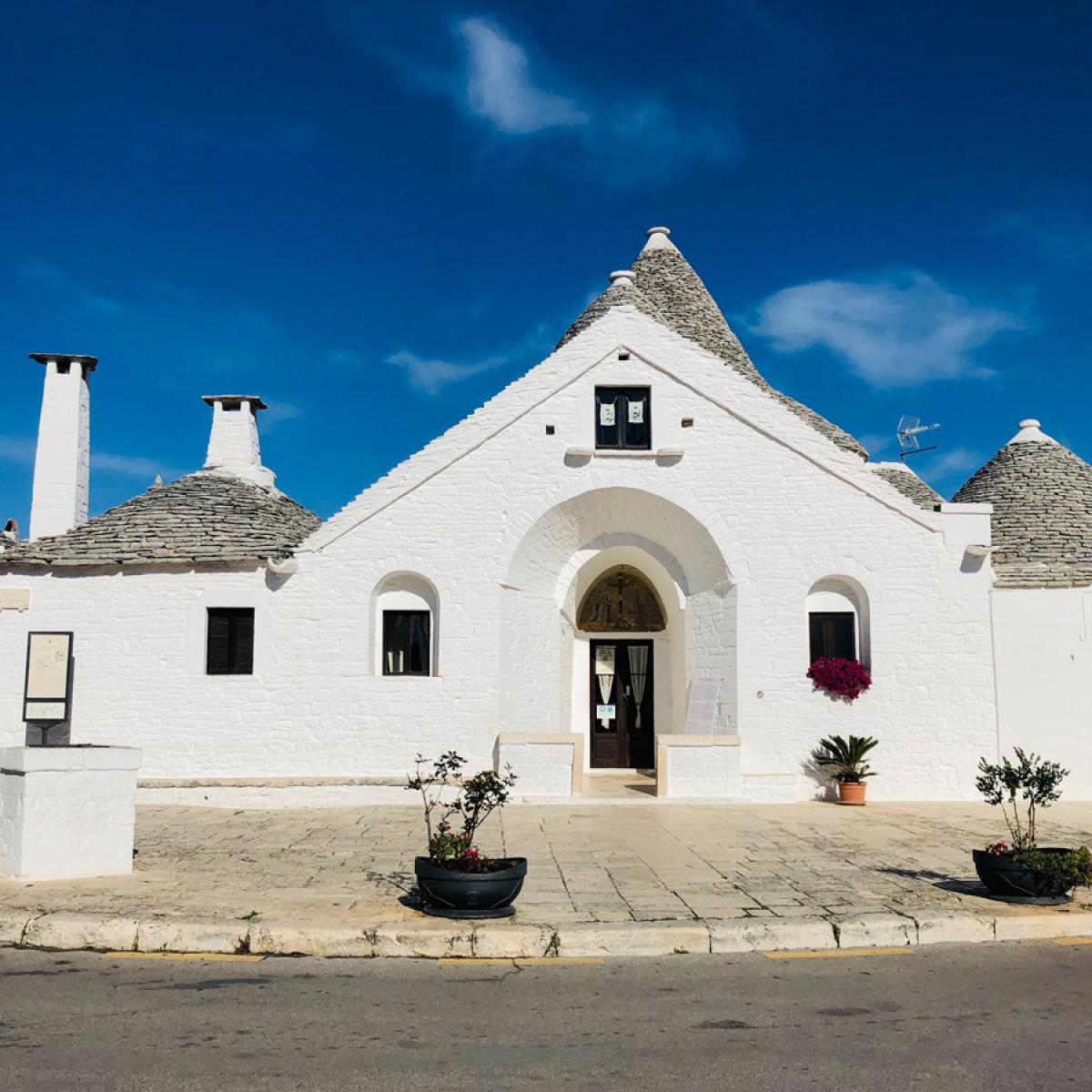
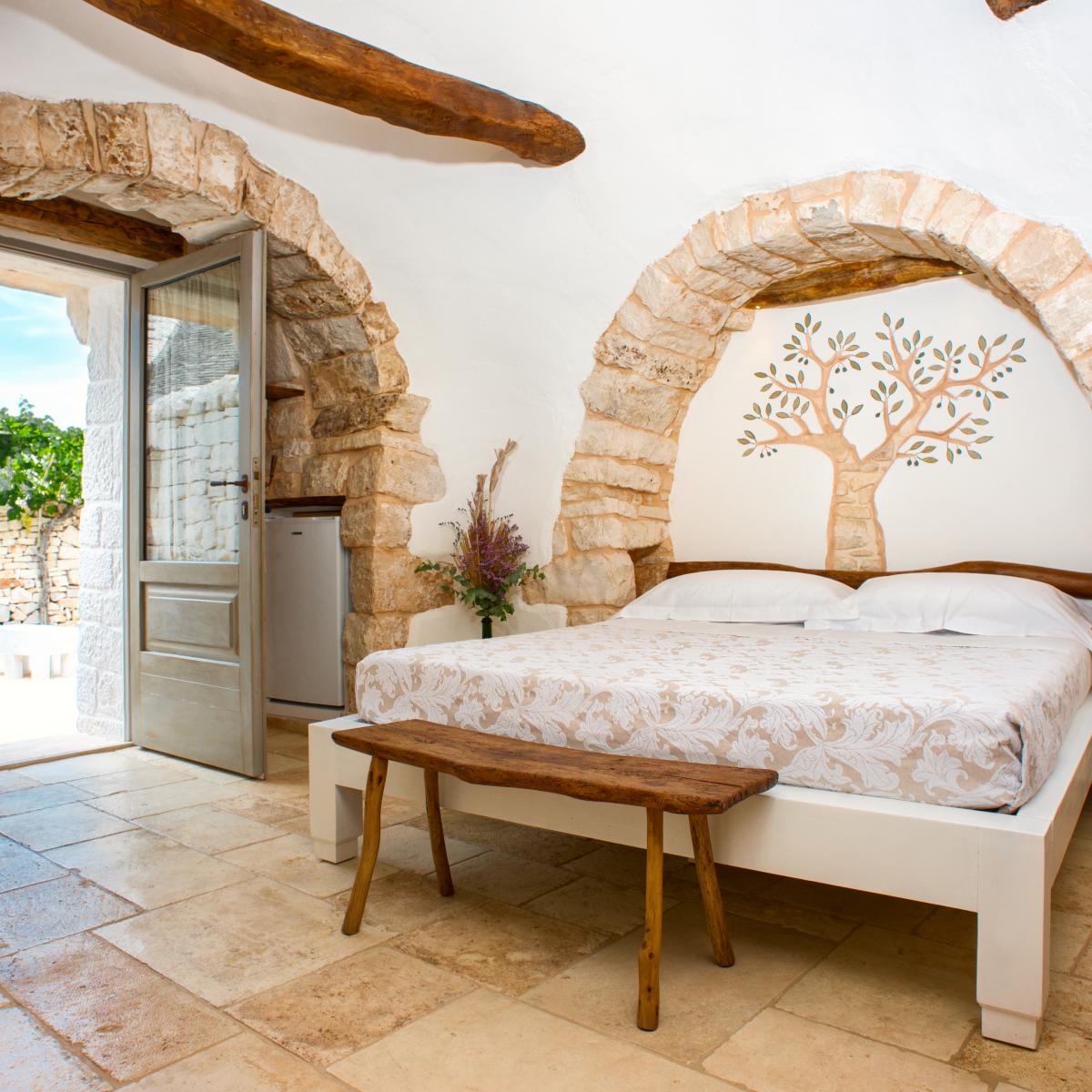
Starting from the Trullo Sovrano (the largest of trulli in Alberobello) to experience staying in a trullo, we propose 10 things to do in the Alberobello. The “trulli town” is easily explored on foot, so park your car and let's begin with this ideal stroll!)
1. Casa d’Amore (“D’Amore House”)
Let's start from the beginning. In the heart of Alberobello, right near the Town Hall, there is a house with a special history: Casa D'Amore, the town's first real house.
In 1797, a pivotal event occurred for Alberobello: it was built the first house using using mortar (unlike the trulli, which were built dry). On the upper floor of Casa d'Amore, precisely on the external façade, you can see the inscription commemorating this event, which also attests to the date of construction. It was in 1797 that Alberobello, at the time only a trulli village, became a "royal city," a title bestowed by King Ferdinand IV of Bourbon. Casa d'Amore, therefore, is not only a historic building, but also a proud symbol of emancipation from feudal rule. Casa D'Amore is also an interesting example of Alberobello's architectural evolution: the gradual transition from trulli to the more modern dwellings that exist today. If you wonder, whether there is a passionate story behind this house name, the answer is... no. It seems that on June 22, 1797, while Alberobello's first mayor was being elected, Francesco D'Amore began building this "terracotta" house.
2. The “Foggia”
Alberobello inhabitants are used to say "Down to the Foggia" referring to the area between the larger and more commercial Rione Monti and the Aia Piccola old town, the more authentic area of approximately 400 trulli. This is a veritable "basin" that once collected rainwater, while today it is an area where people stroll, can sit at cafés, restaurants, ice cream parlors, and visit small shops. A must-see for families who need space and let children run free and enjoy the spectacular trulli view. From the Foggia, you can choose one of the uphill streets and keep on your stroll through the Rione Monti, passing through the magical world of trulli to reach the Sant'Antonio Church, the only sample of a trullo church in the world.
3. Siamese Trulli Legend
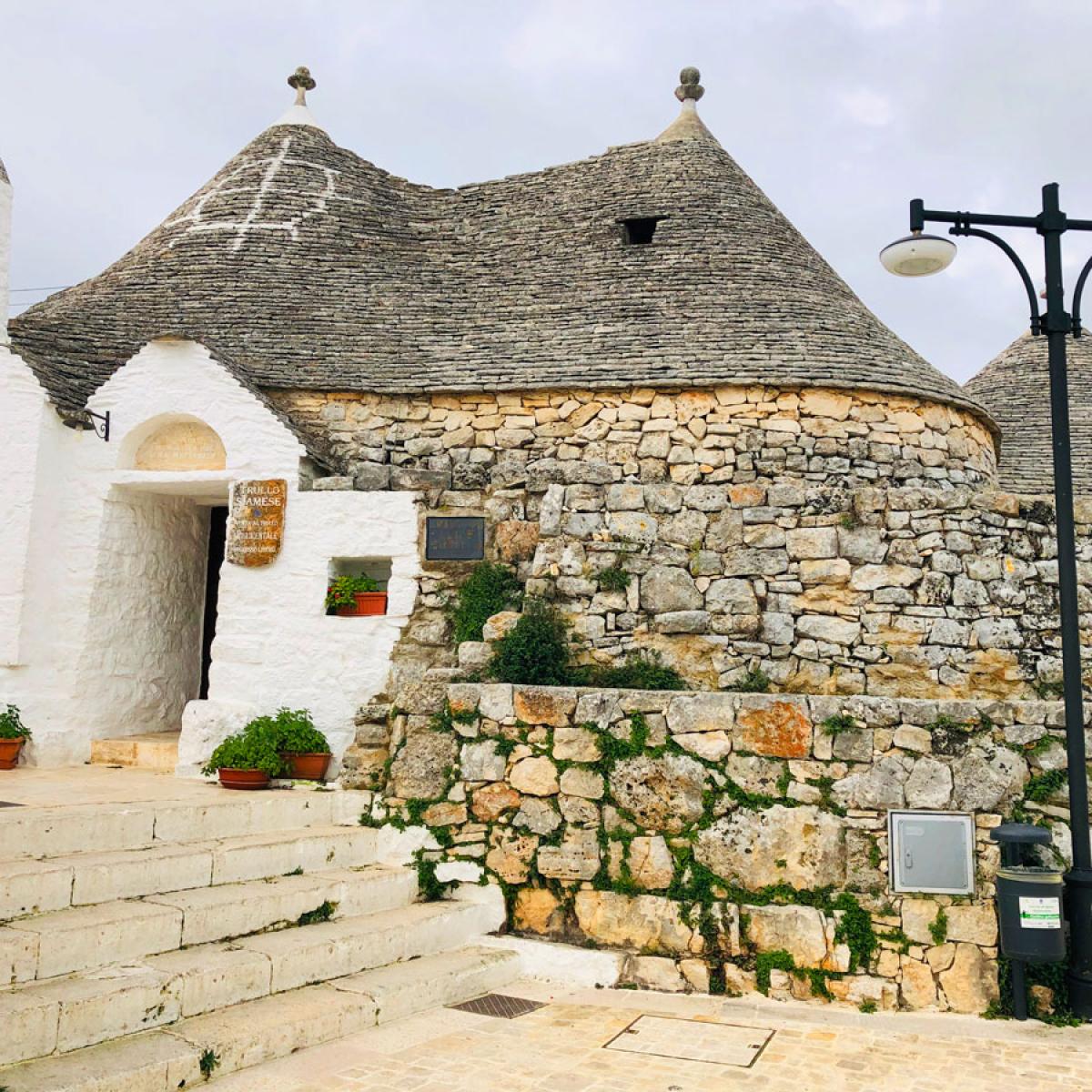
A story comes to life among the trulli every time a tourist stops in front of the Siamese trulli, easily reached by walking up the steps of Via Monte Nero. It is, in truth, a legend that symbolizes the love-hate story that overtook two brothers way back in the 1400s. The structure of these trulli is unique because it is effectively a "double trullo" with two entrances, one for each trullo,
facing two different streets. The originality of the Siamese trulli lies above all in the fact that the rooms were previously connected by a door. If you are curious to discover, how this story of two brothers in love with the same woman (promised to the elder, but infatuated with the younger), gave rise to one of the most original constructions in the world. Walking along Via Monte Nero, you'll find them halfway to the trullo church.
4. The only trullo church in the world
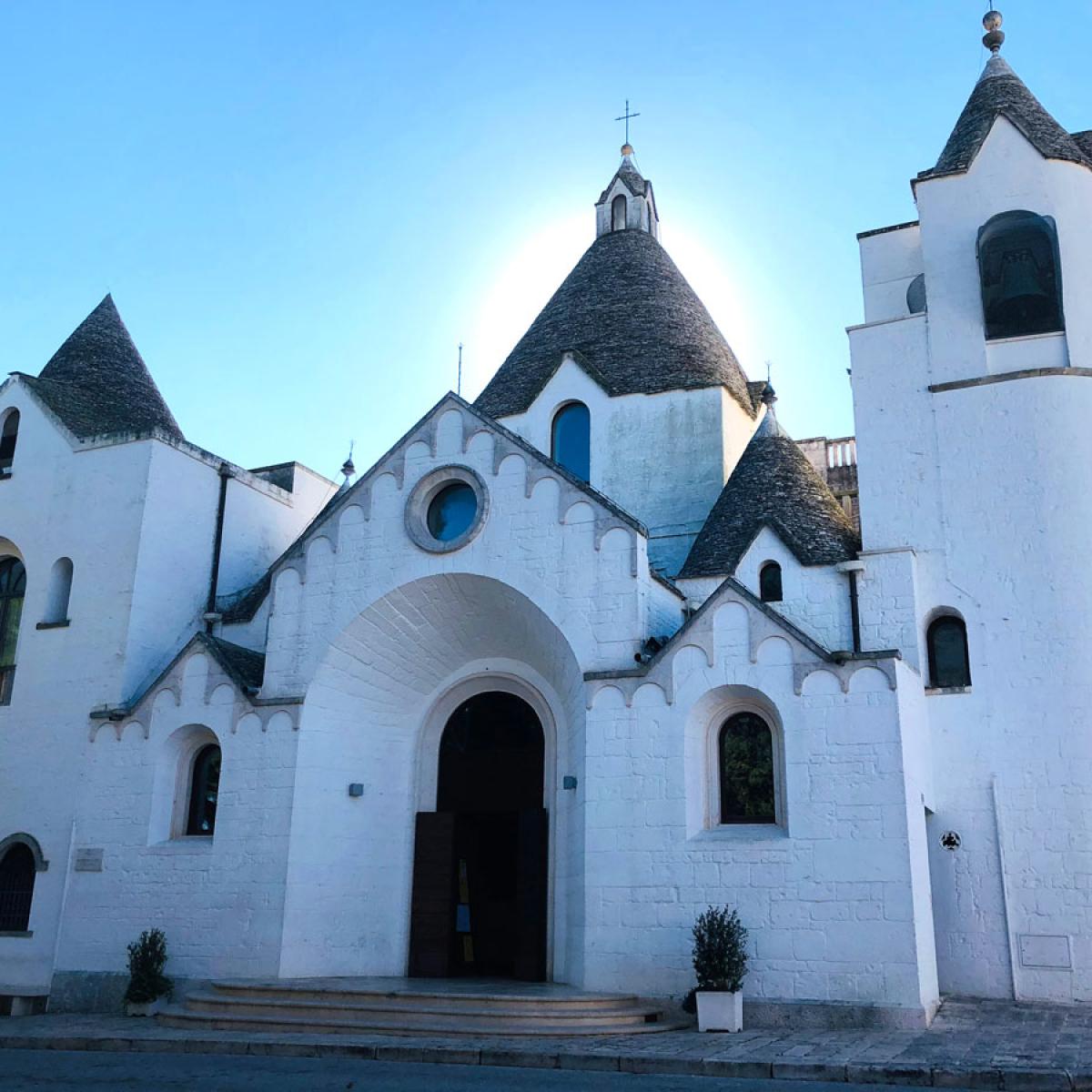
For those who love "unusual" places of worship, the St. Anthony of Padua's Church, inaugurated in 1927 and thus relatively recent compared to the trulli, is a must-see. You can reach it by walking uphill among the trulli of the Rione Monti old town. Upon entering it, you can admire an enormous and rich fresco behind the altar, which immediately captures the visitor's attention as soon as they cross the threshold of the church. We stand before the Tree of Salvation, a gigantic tree whose trunk represents the crucifix of Jesus. The branches of the tree are decorated with circles containing the faces of the saints, while at its feet there are the Madonna and the Apostle John. On the left there are St. Anthony and St. Francis, while on the right there are Sts. Cosmas and Damian. Adam and Eve are kneeling on the ground, welcoming the Lord. An interesting fact: the only trullo church in the world was built in just 14 months.
</div>
5. Aia Piccola old town
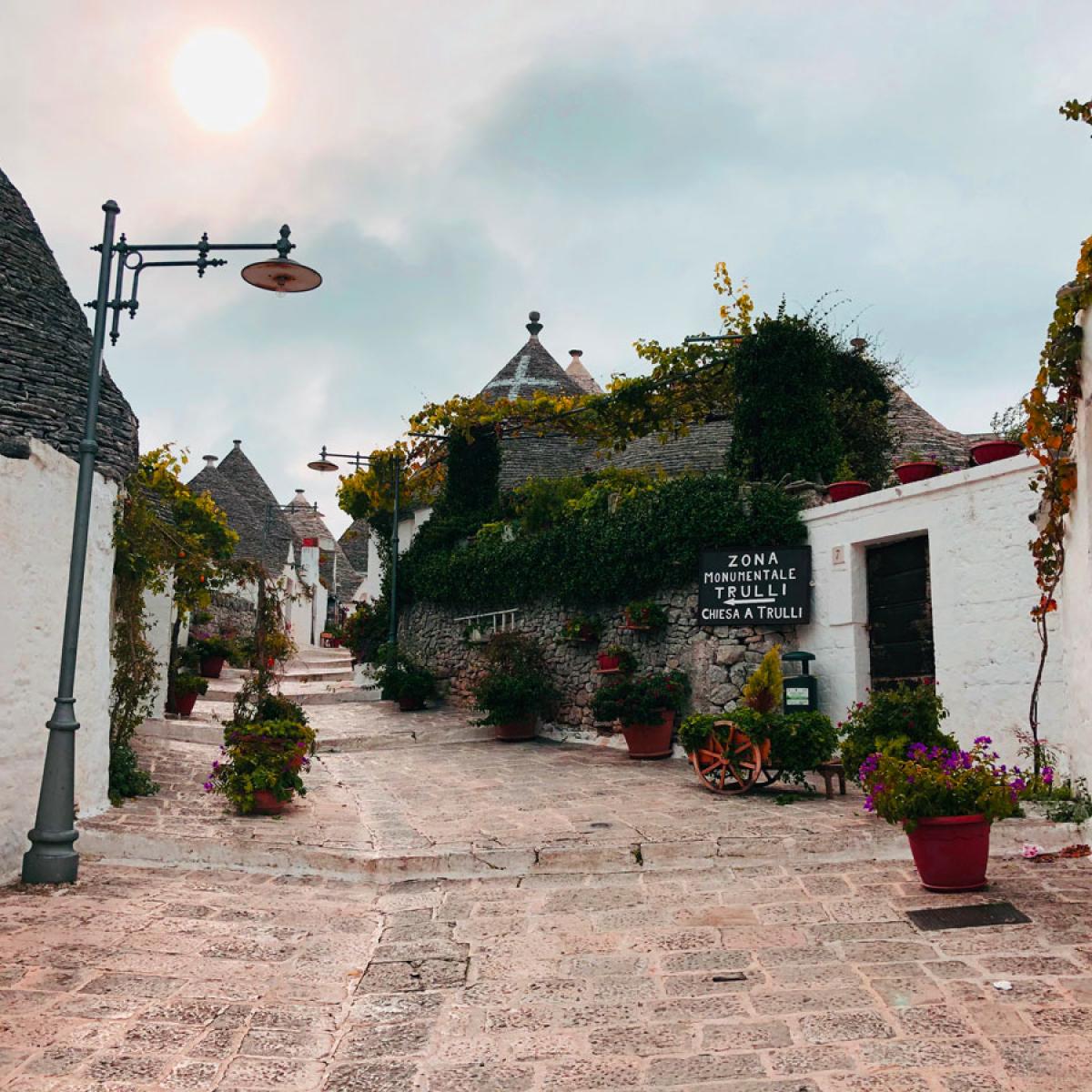
The oldest and most authentic residential area in the town is Aia Piccola, so called because it represents the ancient and industrious peasant farmyard of Alberobello. A name that evokes the ancient custom of threshing wheat in the town square, "small" to distinguish it from the nearby square. In this part of the town, entirely composed of trulli and devoid of any commercial establishments or souvenir shops,life is still slow and simple. If you want to truly delve into the past, simply take a stroll through the narrow streets of the Aia Piccola; probably, an elderly lady sitting outside her trullo will tell you unforgettable stories about this small town of about 11,000 inhabitants, now famous throughout the world. The alleys of Aia Piccola become even more evocative during the Christmas season, when they provide the backdrop for the reenactment of the Nativity.
6. Stroll along the Corso, to the StS. Medici Church
Alberobello people have always done it. Strolling along Corso Vittorio Emanuele, especially on Sunday mornings, is a recurring ritual for meeting friends, chatting, and catching up on local happenings. From Piazza del Popolo to the StS. Medici's Church, you stroll slowly, looking at the shop windows and admiring the splendid 1885 neoclassical façade from afar. For visitors, a stop at this basilica is a must, given that the first evidence of devotion in Alberobello to Saints Cosmas and Damian dates back to the second half of the 17th century. Did you know that during the patron saints's feast, pilgrims walk dozens of kilometers to reach this church and pray these saints?
7. Admire the Trulli Skyline (Belvedere)
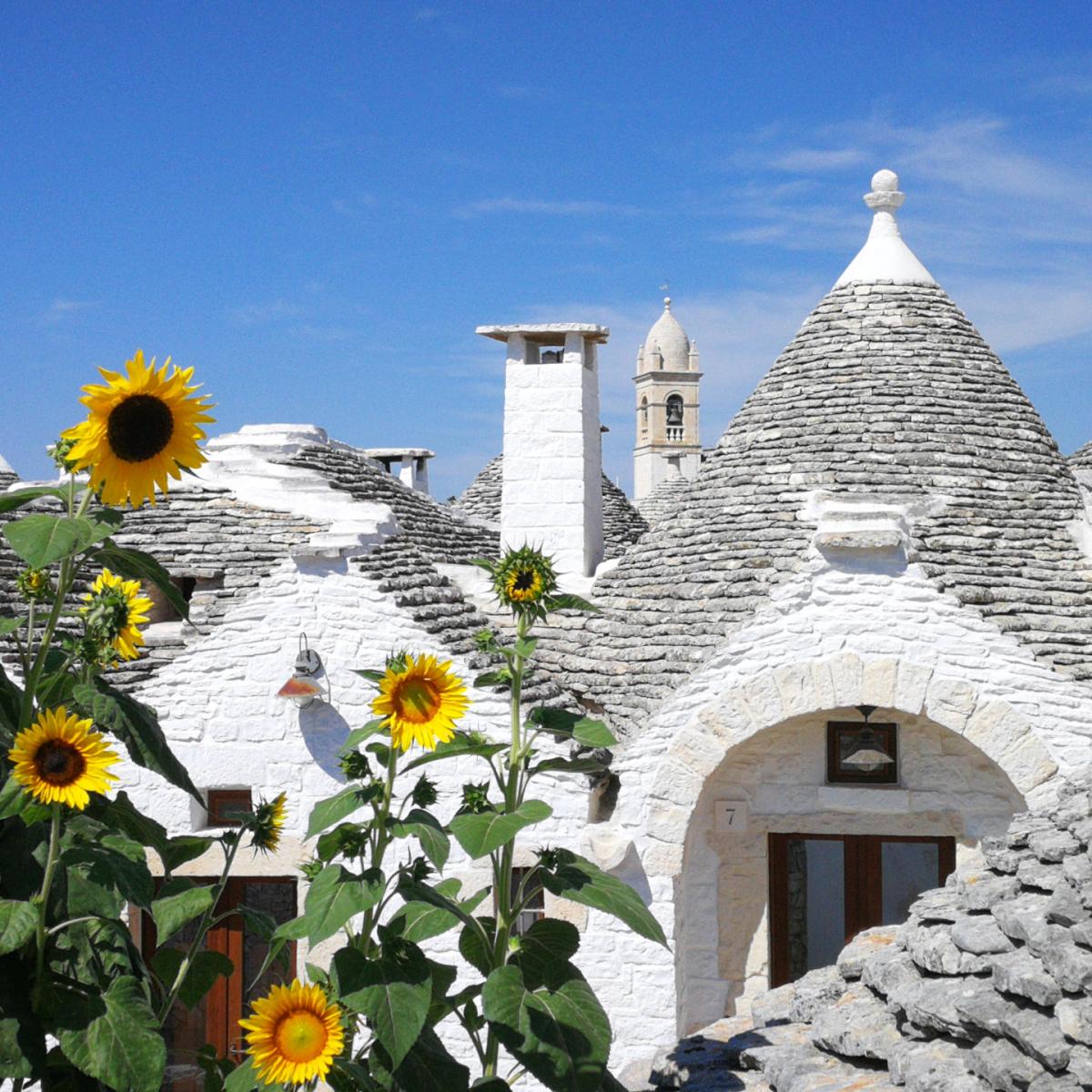
If there is a truly unique skyline in the world, it is that of Alberobello. Nowhere else on the planet you can admire a skyline of conical peaks soaring into the sky. The famous italian poet Pierpaolo Pasolini was dazzled by it and, in a 1951 article, wrote these wonderful words about this horizon: "The pointed roofs, a deep blue black, suddenly detach themselves from this twisted and harmonious base, to fill the sky with magical peaks." Lose yourself in this fairytale view by looking out from the belvedere adjacent to the little Santa Lucia's church, in Piazza GianGirolamo II D'Acquaviva D'Aragona.
8. Rione Monti Old Town
This stop on our Alberobello walk needs little explanation, as the Monti district is Alberobello's best-known, so much so that the town's most popular souvenirs have always been purchased here. The Rione Monti old town is the largest area of trulli (approximately 1,400), consisting of characteristic parallel streets, all ascending and leading to the top of the "monte", where the trullo church is located. In this area, more commercial than the Aia Piccola, it is not uncommon to come across pop-up workshops demonstrating how stone is carved to create trulli or how traditional dishcloths are embroidered.
</div>
9. Trullo Sovrano (King Trullo)
The king of the trulli, the largest in the town, among the first to be built with mortar, boasts a unique feature: it has two floors separated by a masonry staircase, rather than wood like the more common trulli with a mezzanine. The current left wing represents its original core, dating back to the early 1600s, while the remaining section was built in the first half of the 1700s for the wealthy family of the priest Cataldo Perta. He built the structure and used it as a residence, while the adjacent trulli served as living quarters for his employees. Today, the Trullo Sovrano is a museum where you can discover what life was like in Alberobello. It's also a great opportunity to learn about the structure and unique characteristics of the trulli, buildings of peasant origin, built entirely of dry stone using local limestone.
</div>
10. Sleeping and eating in a trullo
Sleeping and dining in a trullo: what a better way to enjoy your Alberobello experience? Staying at Trulli Holiday, the only widespread hotel in trulli, is the ideal way to truly experience Alberobello. Open your eyes and admire the interior of the masterfully constructed cones, the stones placed one by one up to the top of the trullo, savour tradition in the living stone breakfast room, and let yourself be pampered by the comfortable atmosphere of these carefully restored ancient dwellings. Accommodation options are numerous, depending on the characteristics of the trullo: from a love nest for couples with a massage room and outdoor Jacuzzi to fully equipped trulli equipped ideal for families.
</div>